


On Political Liminality: Serbia’s Student Protests and the Remapping of Political Space
 /media/playercomm?action=mediaview&context=normal&id=2652
-
138 views
-
0 likes
-
0 favorites
-

B/Orders
In Motion
- 61 Medien
- hochgeladen 17. Dezember 2025
Lunch Lecture of the Viadrina Institute for European Studies (IFES) in cooperation with the Viadrina Center B/ORDERS IN MOTION.
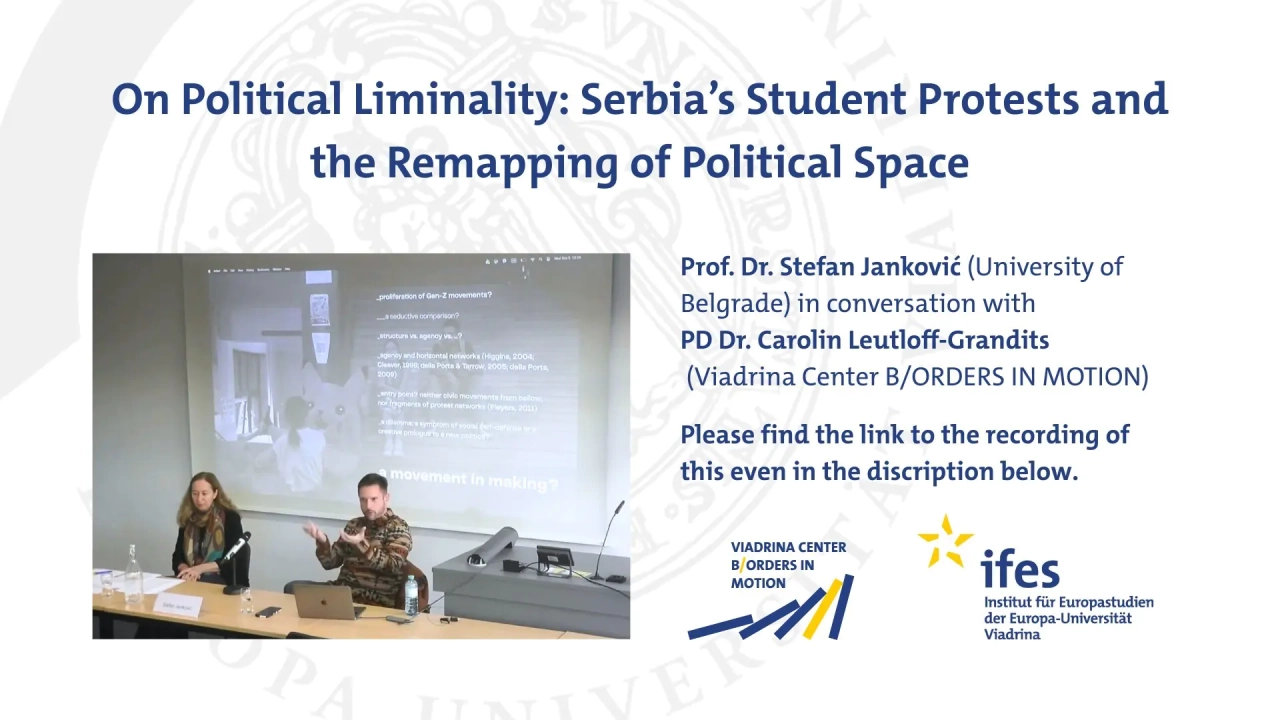
Prof. Dr. Stefan Janković (University of Belgrade) in conversation with PD Dr. Carolin Leutloff-Grandits
Since November 2024, student-led protests sparked by a fatal collapse at the Novi Sad train station have become one of the most significant mobilizations in Serbia’s recent history, pressing for accountability, transparency, and democratic reforms. Over the past year, joined by teachers, high school pupils, and citizens, students have used blockades, strikes, and occupations of media buildings and squares, supported by decentralized networks of coordination, to sustain pressure on state institutions. Whereas the government’s response has oscillated between repression and attempts at delegitimization, the movement’s tactics have shown remarkable persistence and adaptability, posing a serious test for how we conceptualize political mobilization. This talk approaches the student movement through the lens of political liminality. By tracing the material infrastructures of blockades and occupations, we argue that students reconfigured flows, sites, and publics, enacting fragile but concrete re-territorializations of the political space.